Almost every pool owner asks us the same question at some point: which automatic pool cleaner is the best?
The honest answer is it depends on your setup. The right cleaner comes down to how your pool is plumbed, what kind of debris you deal with, how much you want to spend up front, and how involved you want to be in the day-to-day use of the cleaner.
After servicing pools in League City, Friendswood, Pearland, Clear Lake, and surrounding areas for 15 years, we have used and installed all three types. This guide gives you the full picture, including what we actually recommend and why.
There are three types of automatic pool cleaners: Pressure Side, Suction Side, and Robotic. Let’s go through each one.
What Is an Automatic Pool Cleaner and How Do They Work?
An automatic pool cleaner is a device that moves around your pool and removes dirt, debris, and algae without manual effort. The three types work in very different ways.
- Suction side cleaners attach to your pool’s skimmer or a dedicated suction line. They use your existing pump to pull debris off the floor as they move.
- Pressure side cleaners connect to your pool’s return line. They use water pressure, and sometimes a separate booster pump, to propel themselves around and collect debris into a bag.
- Robotic cleaners are fully independent. They plug into a standard electrical outlet and run their own motors, filters, and brushes with no connection to your pool’s plumbing system.
Each type handles debris differently, uses different amounts of energy, and puts different demands on your existing pool equipment.
Pressure Side Cleaner Pros
- All cleaners should be taken out of the pool when shocking, as well as periodically to rinse off chemical water. The reality is that no one takes these steps and generally leave them in the pool 24/7 to run their daily schedules. This means you aren’t messing with the cleaner very often, other than to empty debris out of the bag.
- Pressure side cleaner parts are usually less expensive when it comes to repairs. If you take care of your cleaner and get things repaired when needed the upkeep is fairly inexpensive. If you let problems go unattended it will generally lead to more problems and costly repairs.
- Parts are widely available.
- Some manufacturers offer large rebates and extended warranties.
- Cost of a pressure side cleaner is usually less expensive than a robotic cleaner. (Although, when you add in the cost of a pressure pump to run it, they start to compare to robotic cleaner costs).
What Is an Automatic Pool Cleaner and How Do They Work?
An automatic pool cleaner is a device that moves around your pool and removes dirt, debris, and algae without manual effort. The three types work in very different ways.
- Suction side cleaners attach to your pool’s skimmer or a dedicated suction line. They use your existing pump to pull debris off the floor as they move.
- Pressure side cleaners connect to your pool’s return line. They use water pressure, and sometimes a separate booster pump, to propel themselves around and collect debris into a bag.
- Robotic cleaners are fully independent. They plug into a standard electrical outlet and run their own motors, filters, and brushes with no connection to your pool’s plumbing system.
Each type handles debris differently, uses different amounts of energy, and puts different demands on your existing pool equipment.
Pressure Side Pool Cleaners
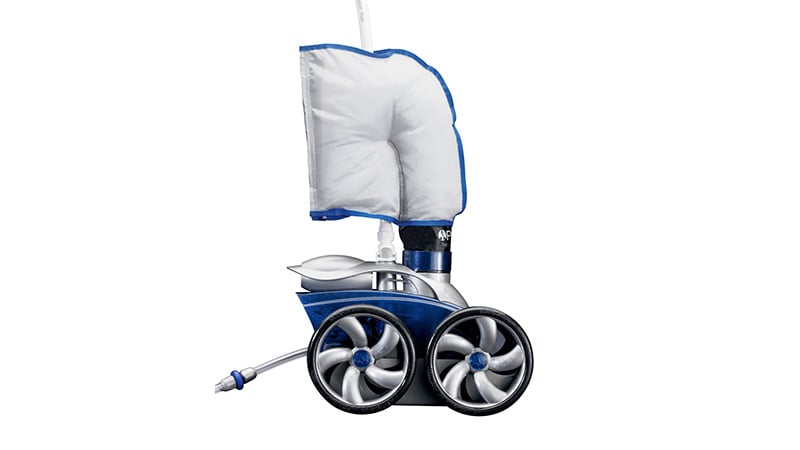
Pressure side cleaners use the water returning to your pool to move and collect debris. The water pressure drives the cleaner around the pool while a separate bag captures leaves, debris, and larger particles. Unlike suction cleaners, they do not send debris through your filter, which reduces strain on your filtration system.
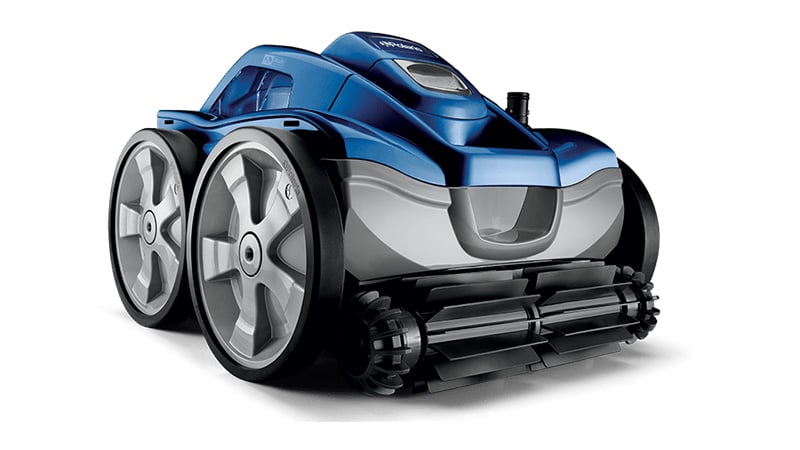
Polaris is by far the most common and popular brand, with the widest range from the entry-level Polaris 280 to their top-of-the-line Quattro Sport model. Many manufacturers offer seasonal rebates and extended warranties when purchased through an authorized local dealer like The Pool Boys.
Pressure Side Cleaner: Pros and Cons
| Pros | Cons |
|---|---|
| Stores debris in its own bag, not your filter | Many models require a separate booster pump, adding cost and another item to maintain |
| Good at picking up medium to large debris like leaves | A booster pump increases monthly electricity use and will eventually need replacing |
| Less filter strain compared to suction cleaners | Models that run off the main pump take significant suction away from filtration |
| Parts are widely available and usually affordable | More wear items than robotic cleaners: tires, bearings, and tail scrubs need periodic replacement |
| Can stay in the pool on a daily schedule with minimal handling | Most entry-level models do not climb walls or clean the tile line |
| Top models like the Polaris Quattro Sport clean walls too | Repairs can be expensive |
| Seasonal rebates and extended warranties available through local dealers | Leaving the cleaner in the pool 24/7 degrades parts faster due to chemical exposure |
The Pool Boys Take on Pressure Side Cleaners
For our weekly service customers, the pressure side cleaner is often our recommendation. We have found that customers using us for weekly service usually will not put a robotic cleaner in the pool or take it back out, since they feel they are paying for pool service. A pressure side cleaner like the Polaris TR28P or Polaris Quattro stays in the pool around the clock doing its job, with no handling required. (The Polaris TR28P is a dealer-only version of the Polaris 280, sold through dealers like us rather than online.) Whether an entry-level or top-tier model needs a booster pump depends on your pool’s system setup. If you want a pressure cleaner, the Quattro Sport climbs walls and does a proper cleaning job, which makes it the one pressure side cleaner we put in the same conversation as a robotic.
Suction Side Pool Cleaners
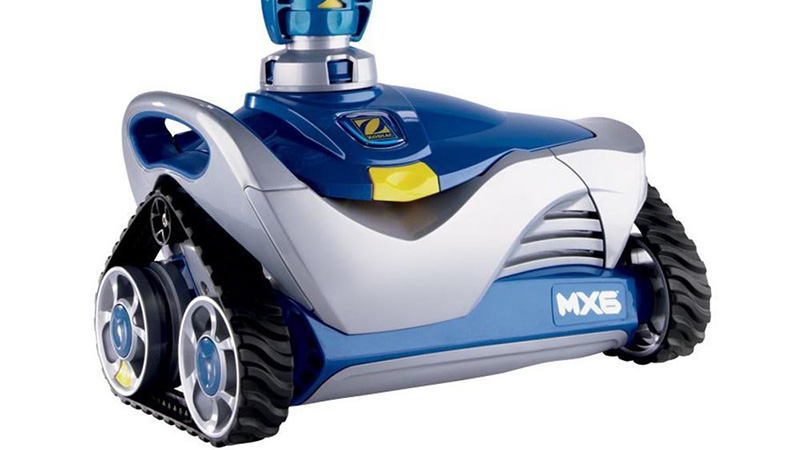
Suction side cleaners are the least common type installed in our market. They connect to your pool’s skimmer or a dedicated suction line and use the suction from your main circulation pump to move and pick up debris. Hayward, Zodiac, and Pentair all make suction side models.
They are the most affordable option up front and require no additional equipment if your pool already has a dedicated suction line. However, their limitations become apparent quickly in pools with heavier debris or more complex shapes.
Suction Side Cleaner: Pros and Cons
| Pros | Cons |
|---|---|
| Lowest upfront cost of any automatic cleaner type | Diverts suction away from skimmers and main drain, hurting water circulation |
| No additional equipment or pump required | Debris goes into your pool’s filter, meaning more frequent filter cleaning |
| Simple to set up if your pool has a dedicated suction line | Requires a dedicated suction line, which many pools do not have |
| Runs continuously as long as your pool pump is running | If plugged into the skimmer port, your skimmer is effectively disabled |
| Parts are inexpensive and easy to find | Requires a leaf canister to prevent clogging underground lines (usually sold separately) |
| Stays close to the pool floor, good at picking up fine sand and dirt | Does not climb walls or clean the tile line; cleaning pattern is random and often misses spots |
The Pool Boys Take on Suction Side Cleaners
Suction side cleaners are the budget option, and you get what you pay for. The biggest problem we see is customers plugging them into their skimmer port because they do not have a dedicated suction line. This disables the skimmer entirely, which hurts water quality. If your pool is not properly plumbed for a suction cleaner, it will create more maintenance problems than it solves. We do not sell suction side cleaners and generally do not recommend them for pools in our service area.
Robotic Pool Cleaners
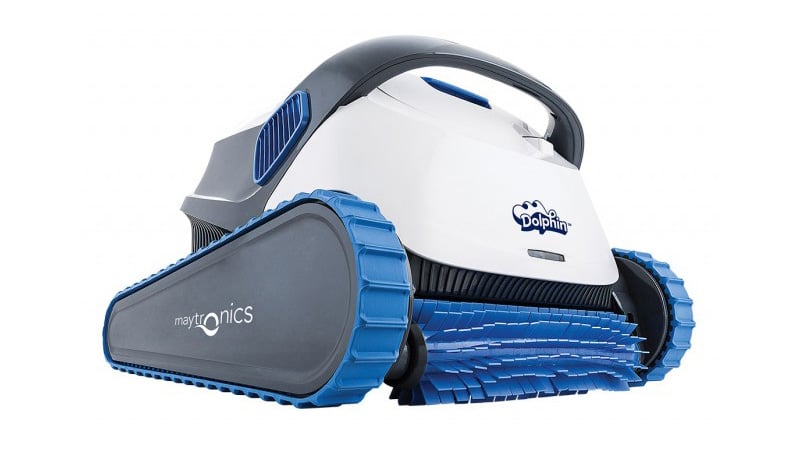
Robotic pool cleaners are the most capable automatic cleaner available. They run entirely on electricity, using their own motors, brushes, and internal filter to clean the pool. They are completely independent from your pool’s plumbing and pump system, which means they do not put any strain on your existing equipment while they run.
Most robotic cleaners clean the floor, walls, and tile line in a single cycle. Higher-end models use navigation systems to map the pool and choose the most efficient cleaning path. Some models have Bluetooth or Wi-Fi connectivity and can be controlled through an app.
For this section, we are focusing on Maytronics, the robotic cleaners we recommend and sell. Maytronics is the manufacturer behind the Dolphin brand, which has been a consistent leader in robotic pool cleaner quality.
Robotic Pool Cleaner: Pros and Cons
| Pros | Cons |
|---|---|
| Cleans floor, walls, and tile line in one cycle | Higher upfront cost than suction or pressure side cleaners |
| Completely independent from your pool’s pump and filtration system | Must be removed from the pool after use, rinsed, and stored out of direct sunlight |
| Motor-driven brushes actively scrub pool surfaces, not just vacuum | Repair parts cost more and may take 1 to 2 weeks to arrive |
| Energy efficient to operate | Most models require a manual cycle start at each cleaning session |
| Longer manufacturer warranties than other cleaner types (some up to 3 years) | Corded models have a cable that can tangle in larger or irregularly shaped pools |
| Debris is stored in an onboard canister or cartridge, not your filter | Heavier than other cleaner types, which makes handling more effort |
| Many models have app control, programmable schedules, and smart navigation; top-loading canister models make emptying easier |
The Pool Boys Take on Robotic Pool Cleaners
Robotic cleaners are the best-performing pool cleaner available, and we recommend them for the true DIY pool owner who will stay on top of placing and storing the unit. When you factor in the cost of a booster pump for pressure cleaners, the leaf canister and plumbing requirements of suction cleaners, and the ongoing repair costs of both, the price gap with robotics narrows quickly. Maytronics is the brand we trust. Their active brushes scrub pool surfaces instead of just vacuuming them, which makes a real difference in cleanliness between cleanings. Proper storage is critical: remove the cleaner after each use, rinse it off, and keep it in a shaded area. This alone will significantly extend its lifespan.
Side-by-Side Comparison: All Three Cleaner Types
Use this table to compare the three types at a glance:
| Suction Side | Pressure Side | Robotic | |
|---|---|---|---|
| Cleans walls + tile line | No | Partial | Yes |
| Needs booster pump | No | Often yes | No |
| Strains pool filter | Yes | No (own bag) | No (own filter) |
| Energy efficiency | Low | Low to medium | High |
| Upfront cost | Lowest | Medium | Highest |
| Repair frequency | Medium | Medium to high | Low to medium |
| Good for heavy debris | No | Yes | Yes |
| Recommended by The Pool Boys | No | Yes (Polaris) | Yes (Maytronics) |
Are Automatic Pool Cleaners Worth It?
Yes, for most pool owners in the Houston area, an automatic pool cleaner is worth it. Here is why.
Houston pools run 12 months a year, and we get a ton of storms throughout the year. That means debris, algae, and dirt accumulate continuously. Without an automatic cleaner, pools require more frequent manual brushing, more chemical adjustments, and more frequent filter cleanings to stay clear. An automatic cleaner reduces all of those maintenance demands between your weekly service visits.
The real question is not whether to get one, it is which type to get. A cheap suction cleaner that disables your skimmer creates more problems than it solves. For our weekly service customers, a pressure side cleaner like the Polaris TR28P or Quattro stays in the pool and works around the clock with no handling. For the hands-on DIY owner, a robotic cleaner used and stored correctly delivers the cleanest results.
We recommend an automatic pool cleaner to every customer on our weekly service route. The cleaner handles the daily cleanup between visits. We handle the water chemistry, equipment checks, and deeper cleaning during your scheduled service.
What Are the Disadvantages of Robotic Pool Cleaners?
Robotic cleaners are the best performers, but they do have real drawbacks worth knowing before you buy.
- Higher upfront cost. A quality robotic cleaner costs more than a suction or pressure side option. Budget models exist, but we do not recommend them. Generic or cheap robotic cleaners tend to perform poorly and require more frequent repairs.
- You have to handle them. A robotic cleaner needs to be removed from the pool after each use, rinsed off, and stored in a cool shaded area. It takes about five minutes and dramatically extends the life of the unit. Most people who skip this step end up replacing their cleaner years earlier than necessary. This is the main reason we steer weekly-service customers toward a pressure side cleaner instead.
- Repair parts take time to arrive. Unlike pressure or suction side parts, robotic cleaner repair parts are often ordered and can take one to two weeks. This is why proper care matters so much.
- Corded models can tangle. In pools with unusual shapes or lots of features, the power cord can get caught. Higher-end models with smarter navigation handle this better. Cordless models eliminate it entirely at a higher price.
Our take: these drawbacks are real but manageable. The performance advantage outweighs them for the hands-on owner who will keep up with placement and storage.
Suction Side vs. Robotic Pool Cleaners: Which Is Better?
For most pools in the Houston area, a robotic cleaner outperforms a suction side cleaner. Here is a direct comparison on the factors that matter most.
- Wall cleaning: Robotic cleaners clean walls and tile lines. Suction side cleaners clean floors only.
- Filter strain: Suction cleaners send debris through your pool’s filter, increasing how often it needs cleaning. Robotic cleaners have their own filter and put zero strain on your pool system.
- Energy use: Suction cleaners rely on your pool pump running longer or harder. Robotic cleaners use low-voltage motors and are inexpensive to run.
- Plumbing requirements: Suction cleaners need a dedicated suction line. Many pools in our area do not have one, which leads owners to plug the cleaner into the skimmer port and disable it. Robotic cleaners just need a power outlet.
The only scenario where a suction side cleaner makes sense is a pool with very light debris, a properly plumbed dedicated suction line, and a tight budget. Outside of that, a pressure side or robotic cleaner is the better long-term investment.
Pressure Side vs. Robotic Pool Cleaners: Which Is Better?
Pressure side cleaners sit between suction side and robotic in terms of capability and cost. For our weekly service customers, a pressure side cleaner is often the better fit because it stays in the pool and needs no handling. For the DIY owner who will manage the unit, a robotic cleaner gives the best cleaning results. Here is how they compare.
- Cleaning coverage: Most pressure side models do not clean walls. The Polaris Quattro Sport is the exception. Robotic cleaners clean walls, floor, and tile line as standard.
- System impact: Pressure side cleaners that require a booster pump add another motor, time clock, and electrical connection to your pad. More equipment means more potential points of failure. Robotic cleaners add nothing to your pad.
- Debris handling: Both store debris separately from your filter. Pressure side cleaners use a bag. Robotic cleaners use an onboard canister or cartridge.
- Energy: A booster pump adds meaningful electricity cost over a full season. A robotic cleaner uses less total energy per cleaning cycle.
- Upfront cost: Pressure side cleaners cost less up front if your pool is already plumbed for one. Once you add a booster pump, the total cost approaches the price of a robotic cleaner.
Our recommendation depends on the customer: pressure side (Polaris TR28P or Quattro) for weekly-service pools that need a set-and-forget cleaner, and robotic (Maytronics) for the hands-on DIY owner who wants the deepest clean. The Polaris Quattro Sport is the one pressure side cleaner we put in the same conversation as a robotic.
How to Choose the Right Automatic Pool Cleaner
When a customer asks us which cleaner to buy, we ask them three questions.
- How much debris does your pool collect? If you have lots of trees and heavy leaf debris, a cleaner with a separate debris bag or large canister is important. Robotic and pressure side cleaners both handle this well.
- How involved do you want to be? If you want to drop it in and forget it for weeks, a pressure side cleaner on a daily schedule requires the least daily effort. If you want the cleanest pool and are willing to handle the cleaner after each use, a robotic cleaner wins on results.
- What is your long-term budget? Factor in booster pump costs for pressure side, leaf canister costs for suction side, and energy costs for all three. The robotic cleaner often has the best total cost of ownership over 5 to 7 years even with its higher upfront price.
We strongly recommend against cheap generic cleaners. They underperform, need more repairs, and rarely last more than a season or two. The brands we carry and trust are Polaris for pressure side and Maytronics Dolphin for robotic.
If you are in League City or the surrounding area and want help choosing the right cleaner for your pool, call us or stop by. We can order any model you need and install it.
Schedule a Weekly Pool Service
The Pool Boys recommend an automatic cleaner to every customer on our weekly service route. The cleaner keeps debris managed between visits. Our technicians handle water chemistry, equipment checks, and deeper cleaning during your scheduled service. Call 832-473-5715 or visit our Weekly Pool Service page to get started.
Frequently Asked Questions
Are automatic pool cleaners worth it?
Yes. For a Houston pool that runs year-round, an automatic cleaner reduces manual brushing, keeps debris from settling, and lowers the overall chemical demand between service visits.
Are robotic pool cleaners worth it?
Yes, for the hands-on owner. Robotic cleaners are the most effective type available. Once you factor in the cost of a booster pump for pressure side cleaners and the plumbing requirements of suction side cleaners, the total cost difference is smaller than most people expect.
What are the disadvantages of robotic pool cleaners?
Higher upfront cost, the need to remove and store the cleaner after each use, and longer wait times for replacement parts. For customers who will not handle the unit, we recommend a pressure side cleaner instead.
Which is better: suction side or robotic pool cleaner?
Robotic, for most pools. Suction side cleaners only clean the floor, strain your filter, and need dedicated plumbing. Robotic cleaners clean walls, tile line, and floor while operating independently of your pool system.
How do automatic pool cleaners work?
Suction side cleaners use your pump’s suction to move and vacuum debris into your filter. Pressure side cleaners use water pressure to propel themselves and collect debris in a separate bag. Robotic cleaners use their own electric motors, brushes, and internal filter to clean independently.
Can you leave a robotic pool cleaner in the pool?
You should not leave it in the pool full-time. Remove it after each cleaning cycle, rinse it off, and store it out of direct sunlight. This step significantly extends the life of the unit. If you want a cleaner that stays in the pool, a pressure side model is the better choice.
How often should I run my robotic pool cleaner?
Two to three times per week is typical for most pools. Pools with heavy debris, large trees nearby, or high bather loads may benefit from more frequent use.
Is a robotic pool cleaner better than a suction pool cleaner for algae?
Yes. Robotic cleaners have motor-driven brushes that scrub surfaces actively. This breaks up algae more effectively than a suction cleaner, which only vacuums and does not scrub.
What is the best robotic pool cleaner for inground pools?
We recommend Maytronics Dolphin cleaners for inground pools. They are reliable, have active brushes, and Maytronics backs their products with strong warranty support. We have used and sold them for years.